


Leaders can usually see the shape of the change ahead. They see the promised land, and they assume most of the work is figuring out what the change needs to be: expanding into new regions, choosing a virtual delivery model, reorganizing teams and roles.
Here's the miss: a decision is not the same thing as a change process. One is a change. The other is a transition. An organization doesn't operate at a larger scale overnight. A sense of connection in a virtual environment doesn't build itself (and neither does the technology behind it). A new team doesn't gel just because you've told them to.
This might sound obvious, but take a second to sit with it. As a leader, where do you assume people will simply shift their behavior? Where do you expect people to change just because you explained your reasoning? Where have you handed someone a script and expected them to follow it, automatically?
Understanding change as a process opens up a wealth of information for leaders. Earlier in this series, we looked at how leaders miss an important human need when they stick to their default leadership style. Understanding the journey people take through change lets us empathize with what they're actually feeling: the losses they're carrying, how badly they need clarity, how much they want to see progress.
So when we start working with leaders, one of the first things we do is normalize what this transition process actually looks like. Our work draws on the framework developed by William Bridges. Today we'll use his Transitions Model to shed light on what's usually happening beneath the surface as people move toward something new.
The Three Phases of Bridges' Transitions Model
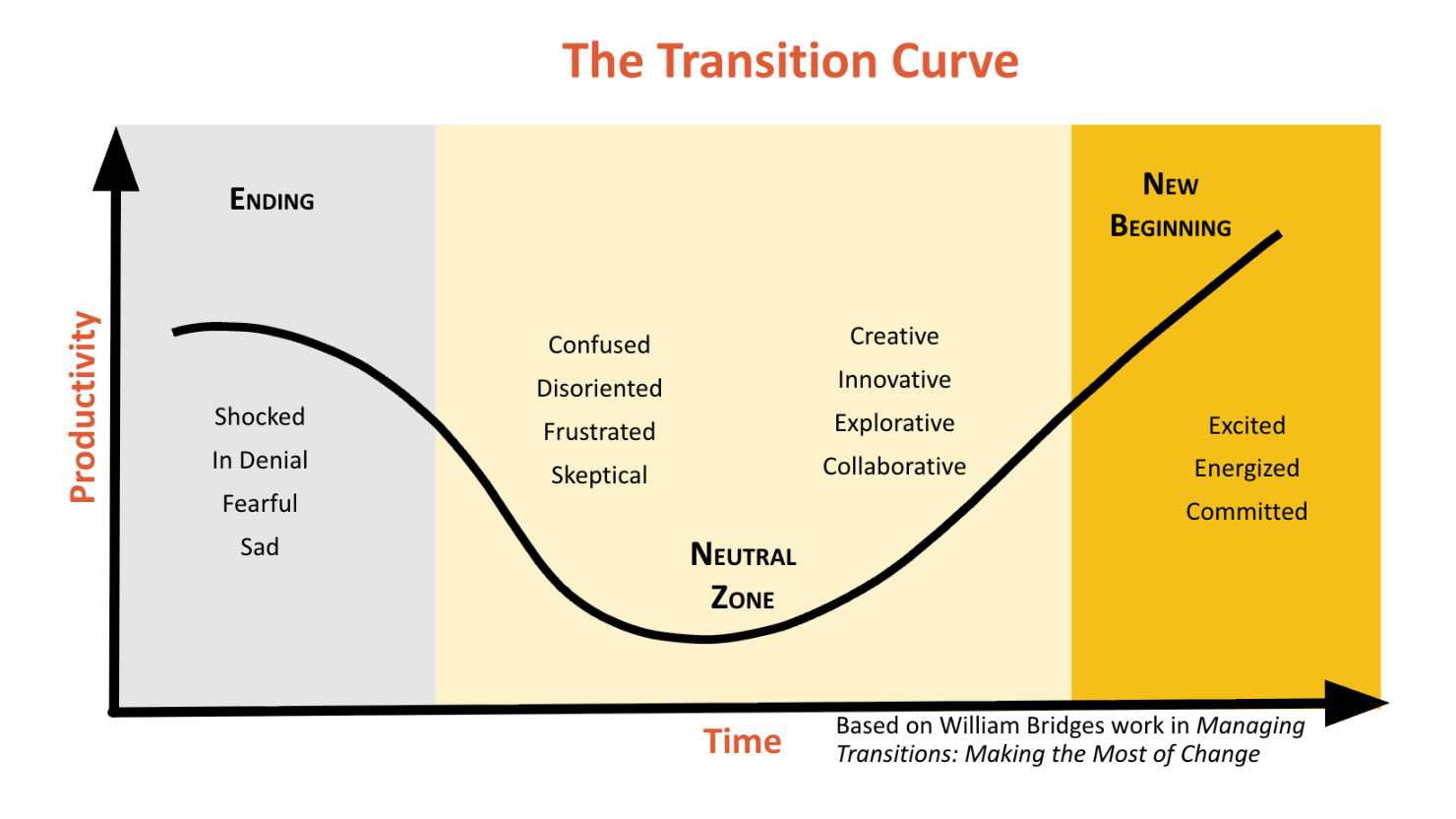
In his book Managing Transitions, William Bridges describes three phases every transition moves through.
Endings
Some endings happen to us (the death of someone we love). Some we choose (moving to a new city means leaving the old one behind). Some arrive sideways, as part of something else (becoming a parent means the end of a certain kind of independence). For an organization choosing to change, this phase starts with acknowledging that something isn't working, then choosing to do something about it.
Endings often carry sadness, fear, shock, or denial. Some people will argue for keeping things as they are. Others won't recognize what they've lost until they're standing in the middle of what's new, complete with its own set of challenges.
The Neutral Zone
This is the space between the past we know and the future we're imagining. Bridges compares it to a kitchen renovation: the old kitchen is gone, stripped down to the studs, no appliances, and the new one exists only as a picture in your head. You're living in neither the old world nor the new one.
Understanding this phase might be the single most important part of leading change well. The old way of doing things no longer works, but the new routines and muscle memory haven't been built yet. People are unlearning and imagining at the same time.
The Neutral Zone is a place of mixed emotions. Having already confronted some of what they've lost, people here are often reaching for a sense of stability, competence, and clarity they don't yet have. It's reasonable for your colleagues to show frustration and skepticism, and to feel overwhelmed or anxious about what's coming.
But the Neutral Zone can also be a place of real innovation, energy, and engagement. Stripped of the old ways of doing things, people get honest about what actually matters. They look inward, drawing on their own values and creativity. They collaborate to figure things out together. Some of the most heartfelt conversations, the best ideas, and the most energizing moments of a change effort happen in the Neutral Zone.
Not all of the progress in this phase is glamorous, though. Moving through the Neutral Zone often means taking steps you can't yet see the payoff for. It means living on faith and possibility, managing the mundane, and celebrating small, incremental shifts before there's anything bigger to celebrate.
New Beginnings
The Neutral Zone isn't the destination. As people start to see what they're working toward, there's progress to mark and new footing to stabilize. New beginnings usually arrive first as glimmers of what's possible, and at some point, people find themselves acclimated to the new way of doing things. There's rarely an official milestone that tells you the transition is complete. Instead, each step through the Neutral Zone is one step closer to what's emerging.
Momentum builds bit by bit. People find the wins along the way and build on them. The new chapter brings its own moments of celebration as people see what they're actually capable of, and its own recommitment to keep adjusting and fine-tuning what's ahead.
Supporting people along the whole journey
Once you understand what the transition looks like for your people, you can build in the right support at the right moment. A few places to start:
Allow for endings. It's tempting to think there's no time to talk about what's ending, But unresolved endings show up later as resistance, grief, or shoulder-shrugging compliance. Giving people a voice in the future ahead is often what helps them actually let go of the past.
Normalize the discomfort of the Neutral Zone. This doesn't mean you can't help things go more smoothly. But some discomfort here is simply part of the territory, born of uncertainty and a loss of footing. You can bring compassion to that discomfort, hold people's doubts lightly, learn to recognize the difference between natural fear and real distress, and make sure everyone, including yourself, gets the care they need while things are in flux.
Get concrete about what's evolving. It's easy to mistake resistance for laziness or a lack of motivation. But once you see the Neutral Zone as a phase of unlearning and reimagining, a different job comes into view: excavating the beliefs and assumptions holding people back, and building the new habits and skills that support where you're headed.
Balance planning with innovating. Some leaders try to plan their way out of the Neutral Zone, then find themselves and their teams frustrated when the plan doesn't hold up. Others surrender to the Neutral Zone entirely and never take a step forward, leaving their staff confused and disheartened because nothing ever feels like progress. The balance sits in between: sketch a general direction, plan the near term with rigor, and leave room to learn and build together as you go.
Orient and celebrate more than you think you need to. To borrow an analogy from the Heath brothers, leading change is often like tapping along to music only you can hear. You know the tune in your head, but everyone else is just hearing taps. You know how this decision connects to what came before; others may not. You can feel the momentum building; others may not see it yet. People need more reminders than you'd expect about where they're headed and how they're getting there. Part of the job is narrating the story the whole group is living, again and again.
Putting this into action
A framework like this one can feel academic on the page. In our next post, we'll get specific about the actions change leaders can take to steward a transition well. For now, it's worth naming what's at stake in ignoring it: there's no guarantee that new beginnings arrive on their own. Left untended, the Neutral Zone can turn into a holding pattern of cynicism and half-hearted compliance. At its worst, people spin in place, lash out, and organizational culture spirals.
We believe your story can go differently. Empathy and support, paired with a clear eye on what's ahead, do more for a team than most leaders give them credit for.
A few questions worth sitting with:
Where is each of your team members right now on the curve, and what does that suggest they need from you?
What losses might they be facing as something ends?
Where might you be underestimating the shift in mindset, behavior, and skill this change actually requires?
Where do you need to flex your own leadership to help them move through it?
This is the second post in our Change Leadership Series. Read more in the series below, or explore how our Change Management work helps leaders steward transitions through the Neutral Zone.
